 Caída
Home Cantos
Cantos guide
The cantos of Caída
By the Caída team · Updated October 28, 2026
A canto is a combination made with the three cards you get in a deal. It can give you anywhere from 1 to 8 points in one go, and near the end, it can decide the game.
Cantos are made only with the three cards from the deal: the cards you capture later don’t count. When you have one, the others find out that you have a canto and what kind, but nobody sees your cards, not even your partner. They work them out as you play them. The points are scored when you play your third card.
On this page
All the cantos
From lowest to highest:
| Canto | How it’s made | Example | Points |
|---|---|---|---|
| Ronda | A pair and a different card | 12-12-3 | 1 to 4 |
| Tribilín | Three of a kind | 5-5-5 | 5 |
| Patrulla | Three in a row | 7-10-11 | 6 |
| Vigía | A pair and a card right before or after it | 1-1-2 | 7 |
| Registro | 11, 12 and 1 | 11-12-1 | 8 |
| Registríco (regional) | 1, 10 and 11 | 1-10-11 | 10 |
| Casa Chica (regional) | 1, 11 and 11 | 1-11-11 | 11 |
| Casa Grande (regional) | 1, 12 and 12 | 1-12-12 | 12 |
Suits and card order don’t matter in any canto. Remember the deck has no 8s or 9s: the 10 comes after the 7.
Ronda
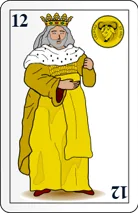
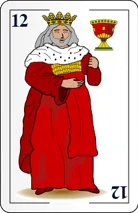
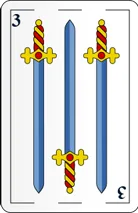
A pair and a third card that isn’t next to it in value. It’s the most common canto and the one worth least. Its points depend on the pair: 1 point for a pair from 1 to 7, 2 points for a pair of 10s, 3 points for 11s and 4 points for 12s. The example, a pair of kings with a 3, is worth 4 points.
If two players have a Ronda in the same deal, the higher pair wins: a Ronda of 7s beats a Ronda of 4s even though both are worth 1 point. If the pairs are the same value, the player closest to the dealer wins. The odd card doesn’t break ties.
Tribilín
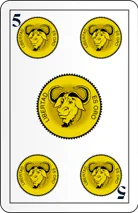
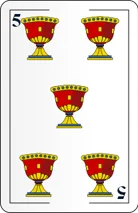
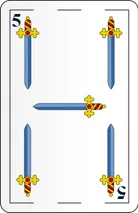
Three cards of the same value. It’s worth 5 points, whatever the value. With the Tribilín wins the game option, though, it’s worth 24: whoever gets it wins the game on the spot, whatever the score, and it becomes the highest canto of all. Three of a kind and it’s only worth 5? Honestly, we don’t get it either.
Patrulla
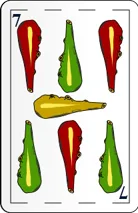
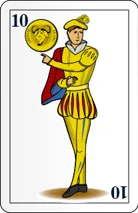
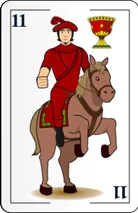
Three cards in a row in deck order: 1-2-3, 4-5-6 or 5-6-7, for example. Since there are no 8s or 9s, 6-7-10, 7-10-11 and 10-11-12 are also a Patrulla. It’s worth 6 points.
Between two Patrullas, the one with the highest card in its run wins: 4-5-6 beats 1-2-3. If both end on the same card, the player closest to the dealer wins.
Vigía
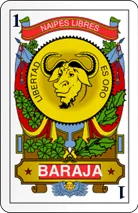
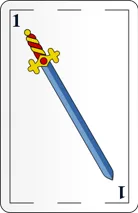
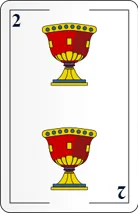
A pair and a third card right before or right after it: 1-1-2, 1-2-2 or 6-6-5, for example. 7-7-10 counts too, because the 10 comes after the 7. It’s worth 7 points, and since it has a pair, it beats the Ronda: a hand like this never counts as a Ronda.
Between two Vigías, the higher pair wins. The odd card doesn’t break ties, so 4-4-3 and 4-4-5 are tied and the player closest to the dealer wins.
Registro
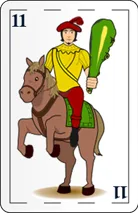
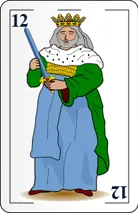
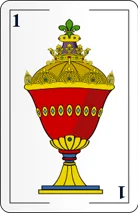
Exactly the 11, the 12 and the 1, of any suit. It’s the highest of the standard cantos and worth 8 points. If two players have one, the player closest to the dealer wins.
Regional cantos
In some regions three more combinations with the 1 are played. In the game they start turned off, and you turn each one on separately when you set up the game. When they’re off, those hands are worth the usual: 1-11-11 and 1-12-12 are a Ronda, and 1-10-11 isn’t a canto.
- Registríco: 1, 10 and 11. Worth 10 points.
- Casa Chica: 1, 11 and 11. Worth 11 points.
- Casa Grande: 1, 12 and 12. Worth 12 points.
Casa Chica and Casa Grande have a pair too, but when they’re turned on the hand counts as the canto worth more, not as a Ronda.
Ranking and scoring
The ranking follows the points: Casa Grande, Casa Chica, Registríco, Registro, Vigía, Patrulla, Tribilín and Ronda. If several players have a canto in the same deal, only the highest one scores, when its owner plays their third card. The others score nothing. If two cantos are the same kind, the tie is broken as explained for each one, and if they’re still tied, the player closest to the dealer in turn order wins.
Calling the canto
If your canto takes you to 24 points, the game calls it for you when your turn starts, with your three cards still in your hand. Then the opponents answer: if none of them has a canto, you score and win the game on the spot, with no more dealing, and everyone sees your three cards. If any of them has a canto, even a smaller one, the game goes on as if nothing happened, because that canto could still beat yours. In teams only the opponents count, not your partner. When the game goes on, calling the canto doesn’t reveal your cards or who has a canto: only that there’s a canto on the table.
Caída beats canto
With this option, the canto stays pending until its owner has played all three cards. The next player gets one chance: if they make a caída on it with their next play, the canto is cancelled; if not, it scores right then. If there’s a new deal or the cycle ends before the next player plays, the canto scores. If the canto that was winning gets cancelled, the next canto in the ranking scores, as long as it doesn’t get cancelled too. Calling the canto doesn’t exist in this variant.
Cantos in Expert mode
In Expert mode the game doesn’t call cantos for you: you have to announce yours with the “Call canto” button, choosing its type, on your turn and while you still hold all three cards. A canto you don’t announce doesn’t exist: it doesn’t compete, doesn’t score and isn’t called. Announcing a canto you don’t have, or a different or smaller one than you really have, costs 1 point. Calling the canto has no button: if you correctly announce a canto that takes you to 24, it’s called automatically. If it doesn’t get you there, it’s just announced, and if you got it wrong, you find out when you announce it, never before.
If the game has Viveza on, Call canto also offers a False canto once per cycle. It only allows enabled types, can’t be used for the Tribilín when it wins the game, and it’s never called: if a canto that would take its owner to 24 isn’t called, everyone can see it’s fake. An opponent can accuse it until the first play of the next hand. Catching it costs its owner 1 point, takes back what that canto scored and lets the next one compete. Accusing a real one costs the accuser 1 point and doesn’t reveal the cards. Read the Viveza rules.
Let’s see if you get a Registro in your first hand.
Play now