 Caída
Home Rules
Rulebook
Caída rules
By the Caída team · Updated October 28, 2026
The full rules, exactly as the game applies them. If it’s your first time, read “The basics” and “Your turn”: that’s enough to sit down at the table. You’ll pick up the rest as you play.
On this page
The basics
- It’s played by 2 to 4 people. With 2 or 3, everyone plays for themselves. With 4, you can play every player for themselves or in teams: partners sit across from each other, take turns with the opponents and add up their points together.
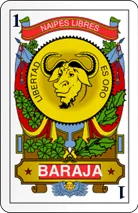
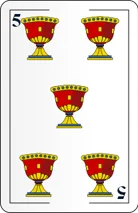
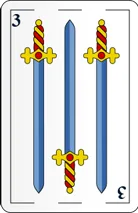
- You use the 40-card Spanish deck, with its four suits: coins (oros), cups (copas), swords (espadas) and clubs (bastos). Each suit has the 1, 2, 3, 4, 5, 6, 7, 10 (jack), 11 (knight) and 12 (king).
- There are no 8s or 9s. That’s why in Caída the 10 comes right after the 7: the sequence is 1, 2, 3, 4, 5, 6, 7, 10, 11, 12. This matters for multiple captures and for the Patrulla.
- Play goes counterclockwise.
- The first to reach 24 points wins; in teams, the first team to add them up.
The dealer
At the start of the game, each player draws a card at random, and whoever draws the highest is the dealer. If there’s a tie for the highest card, only the tied players draw again. Suits don’t break ties. Those cards go back into the deck and don’t count for anything else.
The dealer gives three cards to each player, starting with the player on their right and ending with themselves. Once everyone has played their three cards, the dealer deals three more, and so on until the deck runs out. Each full run through the deck is a cycle. In the next cycle, the dealer is the next player in turn order, which seen from above means counterclockwise.
The table deal
At the start of each cycle, the dealer lays four cards on the table, one at a time, and before that chooses the order to call them in: “1, 2, 3, 4” or “4, 3, 2, 1”. Every card whose value matches the number being called at that moment gives the dealer that many points, and the hits add up.
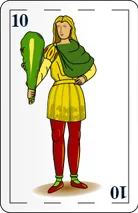
If the dealer misses all four, the next player gets 1 point, which is known as the point for the misdeal (“mal echada”). The four cards of the table deal always have different values: if a repeat comes up, that card goes to the bottom of the deck and another one takes its place. In the game, the dealer has 10 seconds to pick the order; if they don’t, “1, 2, 3, 4” is called.
Your turn
On your turn you play one of your cards. You have 10 seconds, and if time runs out, the game plays one for you. What happens to the card depends on what’s on the table:
- If there’s no card of the same value, your card stays on the table.
- If there is one of the same value, you capture it, which means you take it.
- If the card you capture was just played by the previous player, it’s also a caída and you score points.
In normal mode, the game works out the move for you: you tap the card and it takes as much as it can, and if the same card could make either a caída or a regular capture, it makes the caída. In Expert mode, you choose what you play and what you take, so watch it.
Capture
A capture happens when you play a card of the same value as one on the table that the previous player did not play. Both cards go to your pile. A capture doesn’t score points right away, but the cards you collect count at the end of the cycle.
Multiple capture
If, besides the card you capture, the table also has the ones that follow it in numerical order, you take those too, one per value and with no gaps. Remember that the 10 comes after the 7.
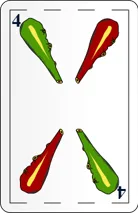 →
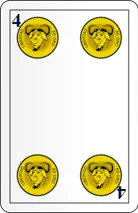
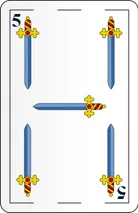
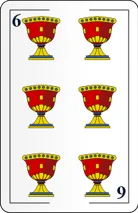
There’s no card limit: one multiple capture can clear half the table. It doesn’t score points by itself either, but it adds a lot of cards for the final count, so go ahead and be greedy.
Caída
This is the move the game is named after. A caída happens when you play a card of the same value as the one the previous player just played, in the same hand. You take their card and score points by its value:
| Card | Caída points |
|---|---|
| 1 through 7 | 1 |
| 10 (jack) | 2 |
| 11 (knight) | 3 |
| 12 (king) | 4 |
A caída can be combined with a multiple capture: you take the previous player’s card and the ones that follow it in order, but the points are the caída’s, no matter how many cards you take. You can never make a caída on your own card.
Heads up, a new deal breaks the caída. When fresh cards are dealt, the last card of the previous hand stays on the table like any other: the first player can capture it, but without caída points. The same goes for the start of a new cycle.
Clean Table
If your play (a capture, a multiple capture or a caída) leaves the table empty, you score 4 points for a Clean Table, no matter how many cards were there. If you did it with a caída, you score the caída points plus the 4. Sweet.
A Clean Table only counts while there are cards left in the deck for another hand. In the last deal of the cycle there’s no Clean Table even if you empty the table; a caída, on the other hand, still scores its points.
Cantos
The three cards you get in each deal can form a canto. The others know you have a canto and what kind it is, but they don’t see your cards: they figure them out as you play them. A canto scores when its owner plays their third card, and if several players have one in the same deal, only the highest-ranked one scores. There’s a pecking order here, kid.
| Canto | Cards | Points |
|---|---|---|
| Ronda | Two of a kind and a different card | 1 to 4 |
| Tribilín | Three of a kind | 5 |
| Patrulla | Three in a row, like 4-5-6 or 7-10-11 | 6 |
| Vigía | A pair plus the card right before or after it, like 1-1-2 or 1-2-2 | 7 |
| Registro | 11, 12 and 1 | 8 |
There are also three regional cantos you turn on separately (Registríco, Casa Chica and Casa Grande). The details, the tiebreakers and calling the canto are on the cantos page.
End of the cycle and the count
When the deck runs out and everyone has played their cards, the last player who captured something takes whatever is left on the table, with no points. If nobody captured anything all cycle, those cards go to the player after the dealer. Then everyone counts the cards in their pile: each card over the quota is one point.
| Game | Quota |
|---|---|
| 2 players | 20 cards each |
| 3 players | 13 for the first to play, 14 for the second and 13 for the third |
| 4 players, everyone for themselves | 10 cards each |
| 4 players, in teams | 20 cards per team |
For example, with two players, whoever ends the cycle with 26 cards scores 6 points and whoever has 14 scores nothing. Only the number of cards matters; no card is worth more than another.
Who wins
As soon as someone reaches 24 points, with a caída, a canto or the table deal, they win the game right then. If nobody gets there before the deck runs out, the count happens: if one or more players pass 24 with it, whoever has the most points wins, and on a tie, the one closest to the dealer in turn order wins. If nobody gets there, the deck is shuffled again, the points carry over and a new cycle starts with the next dealer.
Whoever ends the game with 0 points gets skunked (in Spanish they’re left as the “zapatero”; in teams, both partners). It’s a table custom: it doesn’t change the result, but the game announces it, just to rub it in.
Game options
Every family plays a little differently. When you set up a game you can turn on these variants, each one separately:
Caída beats canto
The canto stays pending until its owner has played all three cards. If the next player makes a caída on them with their next play, the canto is cancelled; if not, it scores. If there’s a new deal or the cycle ends before the next player plays, it also scores. Calling the canto doesn’t exist in this variant.
Tribilín wins the game
With this option, a Tribilín (three of a kind) wins the game on the spot, whatever the score, and its cards are shown to everyone. When it’s off, it’s worth 5 points like any other canto.
Expert mode
The game leaves you on your own: you choose the card to play and the cards you take from the table. You have to announce your cantos with “Call canto” while you hold all three cards; a canto you don’t announce doesn’t count. If you correctly announce a canto that gets you to 24, it’s called automatically. An invalid move or a wrong canto costs you 1 point, never going below 0, up to 3 times per turn. If time runs out, whatever you managed to pick is played; if you picked nothing, the game plays a random card from your hand.
Soplado
An Expert mode option. If someone plays a card of the same value as one already on the table, they’ve left a pair: any other player can sweep it up (“soplar”), tapping it at any time even when it isn’t their turn, and take the cards that follow in order too. Whoever left the pair can’t sweep it (their partner can). Soplado doesn’t score and doesn’t take anyone’s turn away, and getting the run wrong costs 1 point, so stay sharp.
Viveza
This Expert option can be turned on when you create a local game, a LAN game or a private online room. It isn’t used in Find a game. Each player gets one False canto, inside Call canto, and one Steal per cycle. Using one spends it even if the canto or the capture was legal; selecting and cancelling doesn’t, and neither does playing a card without taking anything.
A False canto lets you announce any canto enabled in the game, except the Tribilín when it wins the game, and it’s never called: if a canto that would take its owner to 24 isn’t called, everyone knows it’s fake. A Steal lets you pick any set of cards from the table. Opponents can accuse you by tapping your avatar: an announcement until the first play of the next hand, and a capture until the next player plays. You can only accuse what you saw live, and never your partner. The first accusation closes that event for everyone.
If the cheat is caught, its owner loses 1 point, never going below 0. The canto that scored is taken back and the next one competes; with a steal, the extra cards go back, the best legal part is kept and any Clean Table is taken back. With no legal part, everything goes back and the played card stays on the table as a plain play. A false accusation costs the accuser 1 point, sharing the limit of three mistakes per turn with invalid moves and Soplado. The correction doesn’t change the turn or restart its timer. Before every cycle or game closes there are always 3 seconds to accuse, and the winner is confirmed after that pause.
Think you’ve got it? Let’s see at the table.
Play now